
My search for practical alternatives to the carbon economy has taken me to all kinds of places in the last 15 years. Places within have led to places outside. The journey inside has created new vistas, new friends, new ideas and connections in the world outside. In early October, I visited Birken Buddhist Monastery to process some emotions. There was so much that came up at Birken, that I decided to write a diary about it. Silence is the greatest teacher and Birken had a lot of it.
October 10-2015: It has been a few days since I’ve come back from Birken Buddhist Monastery. I am struggling to find the same peace and connectedness that I felt there in my regular life. Despite my meditation practice, I feel a distinct difference in positive energy. First of all Birken is in a real natural forest. Being so close to nature, calms the human spirit and nourishes it in a way that being away from nature does not. Then the silence is so strong there….in silence we can sense and feel the emotional energy of a place. I felt the intensity of Birken. I felt the intensity of all the souls who came here and thought, and felt, yet their intensity was encapsulated by a profound calmness such that it did not affect me beyond a few sensations that could be looked at and let go.
Coming back from Birken, means embracing the disconnectedness of our collective experience. Most people are unaware of their feelings, and the energy body of unresolved, unprocessed emotion—the pain body that most of us carry is now hitting me either like a sledgehammer or a sharp knife. I have lost the desensitization necessary to cope in the ‘real’ world.
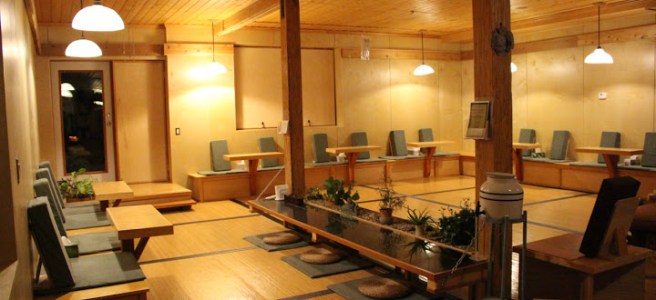
Birken is situated in a forest about 1 mile above sea level. It is the only green monastery. It has an incredibly beautiful wooden building with 3 meditation areas and a really nice kitchen. The house is full of windows from where you can see the hundreds of trees in the forest and the little animals that also live in the forest.
The coolest thing about it is that it is completely off grid and run by solar panels at a tiny fraction of the cost of running a home 5 times smaller. It is approximately 10,000 square feet and costs less than a dollar a day. Interesting design and planning such as motion sensor lights, low flow taps and showers, timed fans, insulated walls and wooden shutters, reduce the need for wood to heat the place.
Monks are not allowed to cook food and handle money, therefore the Monastery depends on volunteer staff to do so for them. In return they give the teachings of wisdom of the Buddha and support the growth and learning of the entire Sangha (community).
Buddhism is unlike any other theistic religion. There is no concept of a creator who magically solves anything. Even though Buddha relates his experiences of communicating with a deity, no belief is required or promoted. Buddhist monks only teach when asked to teach. Meditation is a core principle of the practice. It is so simple that it is easy to understand and put into practice quickly.
People come to meditation when they have tried everything else to deal with the suffering of being alive. Ultimately when nothing works, they are ready for the real thing. Before that, they look for external solutions (for example the sheikh/guru will fix it, dad needs to change, my brother is the problem, my mother did it to me, if I pray hard enough I will go to heaven, or donate to the mandir/religious place for my child’s problem etc). When people learn that blame or craving does not work, they look for internal solutions. The soul’s evolution i.e., real faith comes from within and it comes when we take action and fix the problems we have. It is about willingness to struggle and work hard at ourselves.
Buddha first and last was a scientist of the psyche and mind. He was a psychologist. Thus Buddhism is a ‘way’ like the ‘Taoist’ way. It is a path of the heart. There is ritualistic Buddhism in China and other places, where the Buddha’s statue is worshipped, decorated and used as a symbol of wealth and all the rest of it, but they don’t practice meditation. Birken is based on Theravada Buddhism. It originates from Sri-Lanka and there are Theravada Buddhist monasteries in Thailand and North America. They live in the forest, similar to how Buddha attained enlightenment and ended his suffering, then taught others.
In my last 8 years of honest practice I found over and over again, that every problem, began with me and ended with me. Every suffering I ever had was because of a wrong idea or belief about how life really worked or about how people really are. All my suffering was from fear and untruth. The moment I had insight the suffering ceased. Every time I put in effort, I was rewarded. Every time I lied to myself, I was slapped. Every time I avoided feeling what I truly felt, it didn’t benefit me, because it led to projecting my stuff on to other people. Every time I depended on others to give me love, I was depleted. Repeatedly, my path showed me the wisdom of loving kindness as a way to change the suffering from within and transcend inappropriate mental beliefs and limitations. The beauty of it was that it does not require belief or unbelief in anything. You can have any cultural or religious identity or ritual and still benefit from meditation and the four noble truths.
Mindfulness teaches people to become aware of being aware. It is a way to deepen awareness of being here in present moment consciousness. Thus there is no escaping what is. I recommend mindfulness based practices versus prayer because meditation is practiced as a way to know what is going on inside yourself versus methods that project on to a concept of a God. You can practice mindfulness, de-clutter your mind and feel relaxed and peaceful no matter what your beliefs are!. This is a no drama, no nonsense method to be as clear and as whole as possible.
And if you decide to go the whole way, the monk’s training is a path of direct realization versus prayer to an entity, thus it does not require identification to succeed in ending suffering. It is a more humble goal, rather than transcendence, or heaven with its requisite arrogance. When people meditate, sooner or later they do experience a feeling of divine presence, but that state is not an end in itself, it should not be an excuse to evangelize people or convince them of your religion. People can have all kind of transcendental experiences –but nobody should try to own god and become a ‘voice’ of authority vis a vis god. That’s emotional manipulation.
Fanatical belief can never be mentally healthy. It drives some people crazy, where they lose touch with what is appropriate or balanced in the desire to be ‘right’ or go to heaven or have a following.
Masters of spiritual circles are of often people with an incredibly strong ego (the benefits of the practice) and therefore quite hypnotic to others. When people are suffering, they are going around in a state of deep pain—very easily hypnotizable and some exploit the need for love–of-course that makes me upset. Then I have to study my reaction to it.
As a result I tend to be very careful about who and where I share my energy.
Birken is a an excellent place for peaceful meditation and healing. Ajahn Sona is a monk without an egoic need for a following or any prescription for how things ‘should be’. He is a very real human being with a great sense of humour. Despite his years of practice and genuine level of achievement, he wears his deep awareness with humility and empathy. It is so clear that his own practice is the purpose that drives him, and that makes him a very genuine and real guide. (birken.ca)

 Behind The Veil